

Capital Gains Tax In Canada
How capital gains are taxed in Canada: the one-half inclusion rate, adjusted cost base, capital losses and the superficial loss rule, with a worked example.
Paste it into ChatGPT or Claude to ask questions about it.
Updated Facts checked SourcesView As Markdown
You bought a stock, it went up and you sold it. The profit is a capital gain. In Canada, you don’t pay tax on all of it. You pay tax on half, at your own tax rate. Working out that half takes a little care, and the math starts with what you paid.
What It Is
A capital gain happens when you sell something for more than it cost you. The CRA calls the thing you sold capital property. It includes stocks, ETFs, mutual fund units and real estate like a cottage or a rental property.
The gain is your selling price minus two things. The first is your adjusted cost base, or ACB, which is what you paid plus costs to buy, like commissions. The second is the cost of selling, like another commission.
You don’t pay tax on the whole gain. Half of it is the taxable capital gain. That half is added to your income for the year, and it’s taxed at your marginal tax rate, the same as one more dollar of salary.
Key Rules
- The inclusion rate is one-half. The CRA’s capital gains guide says half of your capital gain is taxable. The government had proposed raising it to two-thirds for larger gains. That increase was cancelled on March 21, 2025, so one-half is the rate in law today.
- Your ACB includes buying costs. The ACB is usually the cost of the property plus expenses to get it, like commissions and legal fees.
- Identical shares use average cost. If you buy the same stock more than once, you don’t track each purchase separately. You add up the total cost and divide by the number of shares you own. That average is your ACB per share.
- Losses only offset gains. When you sell at a loss, half of it is an allowable capital loss. It can reduce your taxable capital gains, but not your salary or other income.
- Unused losses carry back or forward. You can apply a net capital loss to the three years before, or carry it forward to any future year.
- The superficial loss rule. If you sell at a loss and you or your spouse buy the same property within 30 days before or after, and still own it at the end of that window, you can’t claim the loss.
- Foreign currency gets converted. For a US stock, convert the sale price to Canadian dollars at the exchange rate on the day you sold. Convert the ACB at the rate on the day you bought.
- Your home is usually exempt, but you still report it. Since the 2016 tax year, you have to report the sale of your principal residence on Schedule 3 and designate it. The exemption depends on reporting it.
- Registered accounts are different. Gains inside a TFSA, RRSP or FHSA are not reported as capital gains.
- Personal items generally can’t give you a loss. You report a gain on personal-use property, like a boat. But you generally can’t claim a loss on it.
Where A Capital Loss Can Go
When And WhatUse
- Three years beforeApply the loss against taxable capital gains from the three years beforeAllowed
- The year of the lossHalf the loss is an allowable capital loss. It offsets taxable capital gains, not salary.Gains only
- Any future yearCarry what is left forward with no end dateAllowed
The Superficial Loss Window
| What Happens | The Loss |
|---|---|
| You buy the same stock back inside the window and still own it at the end | Denied |
| Your spouse buys it inside the window and still owns it at the end | Denied |
| Nobody buys it back inside the window | Can be claimed |
A Worked Example
Amira lives in Ontario and invests in a regular, non-registered brokerage account. Her marginal tax rate is 29.65%. That’s the combined federal and Ontario rate for 2026 on taxable income between $58,523 and $107,785.
Step 1. Work out the ACB. Amira made two purchases of the same stock.
| Purchase | Shares | Price | Commission | Cost |
|---|---|---|---|---|
| First buy | 100 | $50.00 | $10 | $5,010 |
| Second buy | 50 | $60.00 | $10 | $3,010 |
| Total | 150 | $8,020 |
Her ACB per share is $8,020 divided by 150, which is about $53.47.
Amira's ACB Is The Average, Not The Last Price
Amira's first buy cost $5,010 for 100 shares, $50.10 a share including commission. Her second buy cost $3,010 for 50 shares, $60.20 a share. Together that's $8,020 for 150 shares, an ACB of about $53.47 a share.
Step 2. Sell some shares. Amira sells 100 shares at $70.00 and pays a $10 commission. Her proceeds are $7,000 minus $10, which is $6,990.
Step 3. Find the ACB of what she sold. 100 shares at the average cost is $8,020 times 100 divided by 150. That’s $5,346.67.
Step 4. Find the gain. $6,990 minus $5,346.67 is a capital gain of $1,643.33.
Step 5. Take half. Half of $1,643.33 is a taxable capital gain of $821.67. This is the amount added to her income.
Step 6. Estimate the tax. $821.67 times 29.65% is about $243.63.
So a $1,643 profit costs Amira about $244 in tax. That’s roughly 15% of the gain, because only half of it is taxed. Her remaining 50 shares keep the same ACB of about $53.47 each, for $2,673.33 in total.
Amira's Sale, Worked Through
| Proceeds100 shares at $70.00, less the $10 commission | $6,990 |
| Adjusted cost base of the 100 sharesAverage cost of about $53.47 a share | minus $5,346.67 |
| Capital gain | $1,643.33 |
| Taxable capital gainOne-half, added to her income | $821.67 |
| Tax at her 29.65% marginal rate | about $243.63 |
The $1,643.33 Gain, Split In Half
From Sale To Tax In Five Steps
- Proceeds of the sale100 shares at $70.00, minus a $10 commission$6,990
- ACB of the shares sold$8,020 times 100, divided by 150$5,346.67
- Capital gain$6,990 minus $5,346.67$1,643.33
- Taxable capital gainHalf of $1,643.33, added to her income$821.67
- Estimated tax$821.67 at her 29.65% marginal rateabout $243.63
Only Half The Gain Is Taxed
Not taxedTaxable halfTax
Of Amira's $1,643.33 capital gain, half, $821.67, is taxable. At her 29.65% marginal rate, the tax is about $243.63, roughly 15% of the gain.
Now say Amira had bought these shares in her TFSA instead. There would be no ACB to track, nothing to report and no tax on the $1,643.
Amira's Trade In A TFSA Instead
| Non-Registered | TFSA | |
|---|---|---|
| Track the ACB | Yes | No |
| Report the sale | Yes | No |
| Taxable capital gain | $821.67 | $0 |
| Estimated tax | about $243.63 | $0 |
Common Mistakes
- Using the price of your last purchase. For shares you bought more than once, your ACB is the average across every purchase, not the most recent one.
- Forgetting commissions. Buying costs raise your ACB and selling costs lower your proceeds. Both shrink the gain.
- Selling for a loss and buying right back. Buy the same stock within 30 days and the loss is denied under the superficial loss rule. A spouse buying it counts too.
- Converting US trades at today’s rate. Each side of the trade uses the exchange rate from its own day. Using one rate for both can make the gain wrong.
- Not reporting a home sale. Even when no tax is owed, the sale and the principal residence designation belong on Schedule 3.
- Throwing away old losses. A net capital loss from years ago can still be carried forward against today’s gains.
How Maple Budget Helps
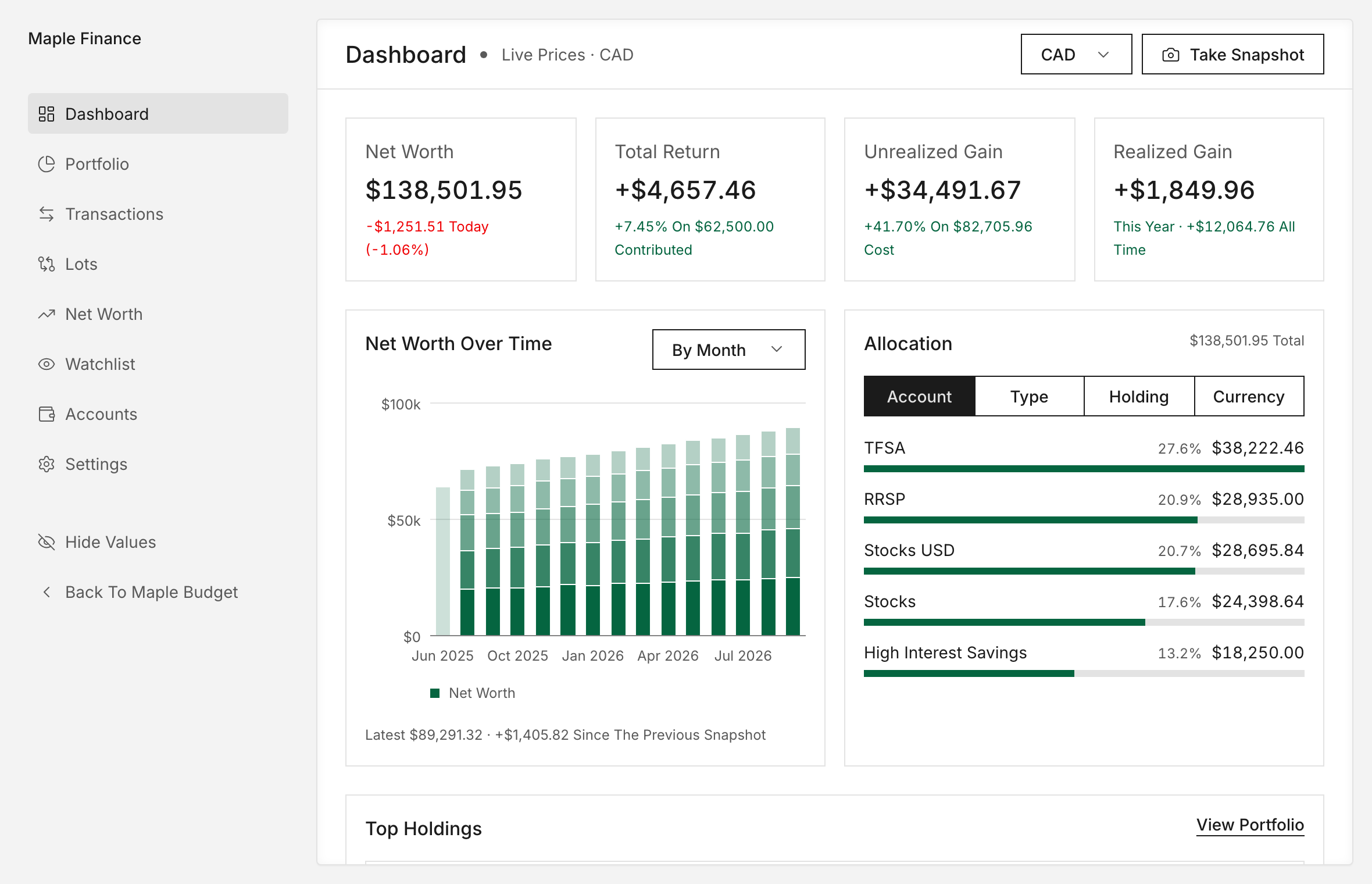
Maple Budget does the ACB math for you. In Maple Finance, log each buy and sell in your investment accounts. Maple rebuilds your positions from your trades using the average cost method, and shows your realized gain for the year as well as your unrealized gain on what you still hold. You can follow the steps in add your investments.
On the web, the Taxes page shows a capital gains estimate for the year. It lists Realized Gains, Allowed Losses, Net Capital Gain and the Taxable (50%) amount added to your income. It shows your Adjusted Cost Base per security, pooled across your taxable accounts and converted to Canadian dollars at the exchange rate you entered for each trade. It also flags superficial losses. Only Non-Registered and Crypto accounts count, so your TFSA, RRSP and FHSA stay out of it.
These are estimates to help you plan. Check with an accountant or the CRA before you file. Maple Finance comes with Maple Pro, which starts with a 7-day free trial.
This is general information, not tax, legal or financial advice. Your own numbers depend on your situation, so check with the CRA or an accountant before you act.
Common Questions
How Much Of A Capital Gain Is Taxed In Canada?
One-half. Under current law, half of your capital gain is added to your income and taxed at your marginal rate. A plan to raise the rate to two-thirds was cancelled on March 21, 2025.
Do I Pay Capital Gains Tax In A TFSA Or RRSP?
No. Gains inside a TFSA, RRSP or FHSA are not reported as capital gains. TFSA withdrawals are not taxed. RRSP withdrawals are taxed as regular income instead.
Can A Capital Loss Lower My Tax On My Salary?
No. A capital loss can only be used against capital gains. If you have no gains this year, you can apply the loss to gains in the three years before or carry it forward with no time limit.
Do I Pay Capital Gains Tax When I Sell My Home?
Usually not, if it was your principal residence for every year you owned it. You still have to report the sale and make the designation on Schedule 3 of your return. If you don't, the CRA may not allow the exemption.
Sources
Every number on this page was checked against these official pages.
- Capital Gains 2025, Guide T4037 (CRA), checked November 16, 2026
- Prime Minister Carney Cancels Proposed Capital Gains Tax Increase (Prime Minister Of Canada), checked November 16, 2026
- Reporting The Sale Of Your Principal Residence (CRA), checked November 16, 2026
- Tax Rates And Income Brackets For Individuals, Current Year (CRA), checked November 16, 2026
- Before You Contribute To A TFSA (CRA), checked November 16, 2026
- Registered Retirement Savings Plan (CRA), checked November 16, 2026
Try It In Maple Budget
Budgeting is free on iPhone, Android and the web. One account works everywhere.