

TFSA Vs RRSP Vs FHSA: Which Account Comes First
How the TFSA, RRSP and FHSA compare on tax, limits and withdrawals in 2026, with a worked example of when each one comes out ahead.
Paste it into ChatGPT or Claude to ask questions about it.
Updated Facts checked SourcesView As Markdown
Canada gives you three main registered accounts for your own savings. They all shelter growth from tax, but they work in different ways. The right order depends on what the money is for and on your tax rate.
What It Is
The TFSA (Tax-Free Savings Account) takes money you’ve already paid tax on. Nothing comes off your taxes when you put it in. Growth and withdrawals are tax-free, and you can take money out for any reason.
The RRSP (Registered Retirement Savings Plan) works the other way. Contributions are deductible, so they lower your taxable income today. Growth is not taxed while it stays in the plan. You pay tax when you take money out.
The FHSA (First Home Savings Account) mixes the two for one goal. Contributions are deductible like an RRSP. A qualifying withdrawal to buy your first home is tax-free like a TFSA.
Where The Tax Break Lands In Each Account
| Stage | TFSA | RRSP | FHSA |
|---|---|---|---|
| Putting money in | No deduction | Lowers your tax | Lowers your tax |
| While it grows | Not taxed | Not taxed | Not taxed |
| Taking it out | Not taxed | Taxed as income | Not taxed for a first home |
A tax break at this stageNo break at this stage
Key Rules
| TFSA | RRSP | FHSA | |
|---|---|---|---|
| Contributions lower your tax | No | Yes | Yes |
| Withdrawals taxed | No | Yes | No, for a qualifying home purchase |
| 2026 room | $7,000 dollar limit, plus unused room | 18% of 2025 earned income, up to $33,810 | $8,000 a year, $40,000 lifetime |
| Unused room carries forward | Yes | Yes | Yes, up to $8,000 |
| Who can open one | Residents 18 and over with a SIN | Anyone with earned income, until the end of the year they turn 71 | First-time home buyers 18 to 71 who live in Canada |
A few rules matter most when you compare them:
- TFSA room builds every year from age 18. It doesn’t depend on income. The 2026 dollar limit is $7,000.
- RRSP room depends on earned income. Your limit is 18% of last year’s earned income, up to the yearly maximum, minus any pension adjustment, plus unused room. The maximum is $33,810 for 2026.
- FHSA room only starts when you open one. You get $8,000 of room in the year you open your first FHSA. Unused room carries forward, but only up to $8,000.
- First-time has a set meaning. For the FHSA, you count as a first-time home buyer if you haven’t lived in a home you owned, or jointly owned, this year or in the past four calendar years.
- The FHSA and the Home Buyers’ Plan can stack. The Home Buyers’ Plan lets you take up to $60,000 from your RRSP for a first home and pay it back later. You can use it and an FHSA withdrawal for the same home.
A Worked Example
Sam lives in Ontario and earns $85,000 of taxable income. At that income, Sam’s combined federal and Ontario marginal rate is 29.65%. That’s the rate on the next dollar earned. The marginal tax rate guide shows how to work it out.
Sam has $5,000 of pre-tax pay to save and is trying to pick between a TFSA and an RRSP. To keep it fair, assume the money doubles before Sam takes it out.
The RRSP route. Sam contributes $5,000 and deducts it. That cuts Sam’s tax by $5,000 times 29.65%, which is $1,482.50. The $5,000 doubles to $10,000. Sam withdraws it later and pays tax on all of it.
- If Sam’s rate at withdrawal is still 29.65%, Sam keeps $10,000 minus $2,965, which is $7,035.
- If Sam’s rate later is 20%, Sam keeps $10,000 minus $2,000, which is $8,000.
The TFSA route. The $5,000 is taxed first. Sam keeps $5,000 minus $1,482.50, which is $3,517.50, and puts that in the TFSA. It doubles to $7,035. Sam takes it out tax-free and keeps $7,035.
What Sam Keeps From $5,000 Of Pre-Tax Pay
KeptTax on the withdrawal
If the money doubles, Sam keeps $7,035 with a TFSA. With an RRSP, Sam keeps $7,035 if the tax rate at withdrawal is the same 29.65%, and $8,000 if it is 20%.
Sam's $5,000, Two Routes
| Step | RRSP | TFSA |
|---|---|---|
| Pre-tax pay to save | $5,000 | $5,000 |
| Tax now at 29.65% | $0, it is deducted | minus $1,482.50 |
| Goes into the account | $5,000 | $3,517.50 |
| After the money doubles | $10,000 | $7,035 |
| Tax coming out at 29.65% | minus $2,965 | $0 |
| Sam keeps | $7,035 | $7,035 |
What Sam Keeps, By Tax Rate At Withdrawal
RRSPTFSA
Line chart of what Sam keeps after the $5,000 doubles, by tax rate at withdrawal from 15% to 45%. The TFSA line is flat at $7,035. The RRSP line falls from $8,500 at 15% to $5,500 at 45%. They cross at 29.65%. At 20% the RRSP keeps $8,000.
The lesson is simple. When the tax rate going in matches the rate coming out, the two accounts end in the same place. The RRSP pulls ahead when your rate later is lower than it is today. The TFSA pulls ahead when your rate later is higher, or when you need the money before retirement.
A Rough Order Of Questions
- Are you saving for your first home, and do you count as a first-time buyer?YesLook at the FHSA firstDeduction going in, tax-free out for the homeNo
- Might you need the money before retirement?YesLean toward the TFSAWithdrawals are tax-free, for any reasonNo
- Do you expect a lower tax rate when you take it out?YesThe RRSP pulls aheadDeduct at today's rate, pay at the lower oneNo
- TFSA or RRSP can land the sameCheck your marginal rate before you choose
Now say Sam rents and hopes to buy a first home in five years. The FHSA gives Sam the RRSP’s deduction now and the TFSA’s tax-free withdrawal later. If Sam opens one in 2026 and puts in $8,000 a year, Sam reaches the $40,000 lifetime limit after five years. If a first home is the goal, that mix is hard to beat.
Sam's FHSA At $8,000 A Year
If Sam opens an FHSA in 2026 and contributes $8,000 a year, total contributions are $8,000 in 2026, $16,000 in 2027, $24,000 in 2028, $32,000 in 2029 and $40,000 in 2030, the lifetime limit.
Common Mistakes
- Treating the RRSP refund as spending money. The RRSP only matches the TFSA if the refund gets saved too. Spend it and you’re behind.
- Waiting to open an FHSA. FHSA room starts the year you open the account, not the year you turn 18. Opening one early, even with a small deposit, starts your room building.
- Using an RRSP for short-term savings. RRSP withdrawals are taxed in the year you take them. A TFSA is built for money you might need soon.
- Forgetting the room is shared. Two TFSAs or two FHSAs at different banks share the same room. Add them up before you contribute.
- Comparing accounts without knowing your rate. The whole RRSP versus TFSA question turns on your marginal rate. Look it up before you decide.
How Maple Budget Helps
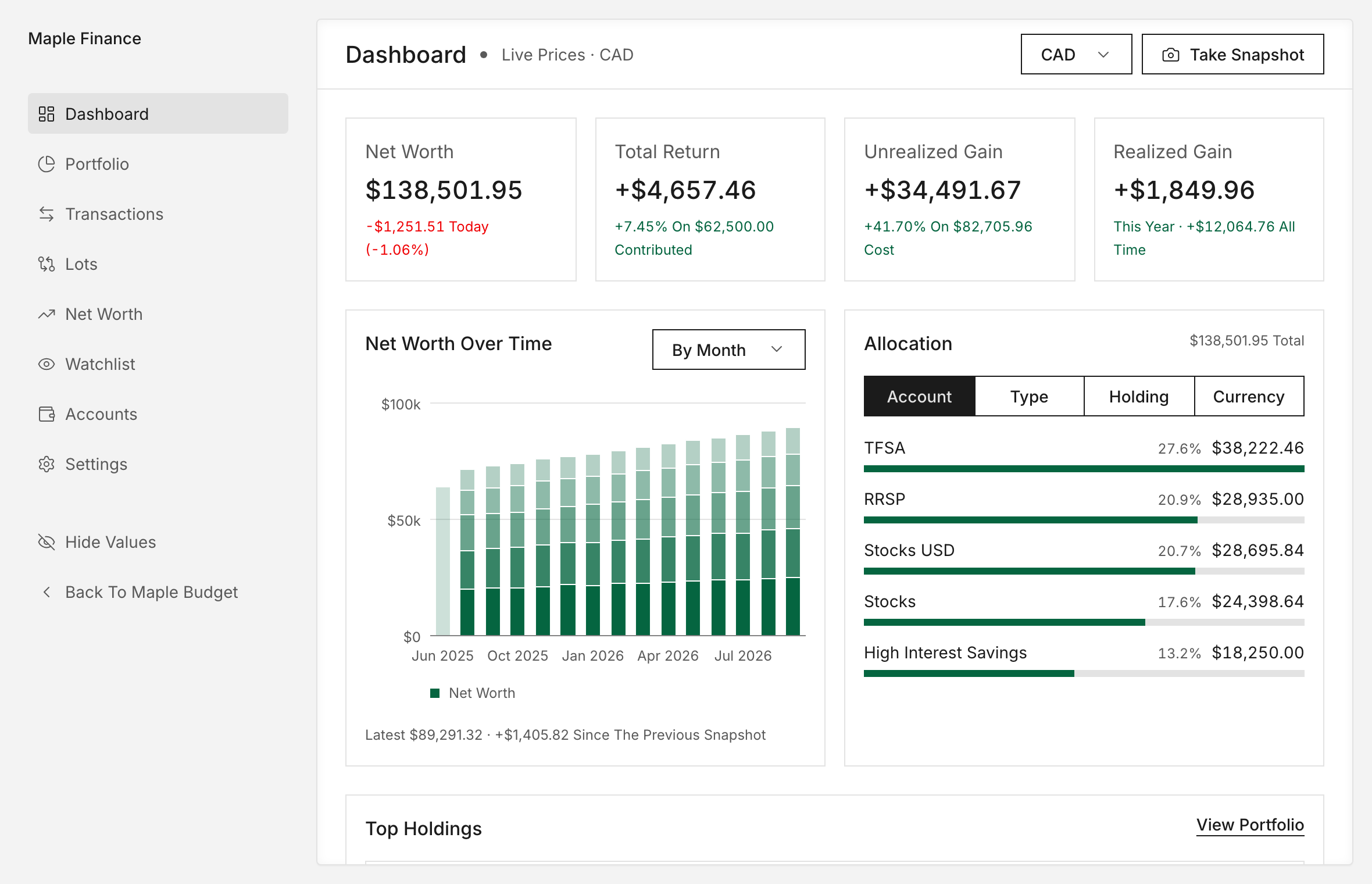
Maple Budget can’t tell you which account is right for you. It can make the numbers easy to see. In Maple Finance, add your TFSA, RRSP and FHSA as separate accounts and see what each one holds, with live prices and total return. The steps are in add your investments.
On the web, the Taxes page keeps your TFSA, RRSP and FHSA room side by side. Enter the room from your Notice of Assessment, log each contribution, and Maple shows what’s left in each account. It shows the FHSA against its $40,000 lifetime limit too. See track your TFSA, RRSP and FHSA room.
Deciding how much to save starts with your budget. Maple shows your income against your spending each month, so you can see what’s actually left to put away.
This is general information, not tax, legal or financial advice. Your own numbers depend on your situation, so check with the CRA or an accountant before you act.
Common Questions
Should I Max Out My TFSA Or RRSP First?
It depends on your tax rate now compared with what you expect when you take the money out. An RRSP tends to win when your rate is higher today. A TFSA tends to win when your rate is low today or you may need the money sooner. This is general information, so check your own case with an accountant.
Can I Have A TFSA, RRSP And FHSA At The Same Time?
Yes. Each account has its own room, and you can hold all three. The FHSA is only for people who qualify as first-time home buyers.
Can I Use The FHSA And The Home Buyers' Plan For The Same Home?
Yes. The CRA lets you make a qualifying FHSA withdrawal and an RRSP withdrawal under the Home Buyers' Plan for the same home, as long as you meet the conditions for each one when you withdraw.
Which Account Is Best For An Emergency Fund?
A TFSA is usually the easiest fit. You can take money out at any time without tax, and the room comes back on January 1 of the next year. RRSP withdrawals are taxed, and FHSA money is meant for a first home.
Sources
Every number on this page was checked against these official pages.
- Calculate Your TFSA Contribution Room (CRA), checked November 16, 2026
- Registered Retirement Savings Plan (CRA), checked November 16, 2026
- How Contributions Affect Your RRSP Deduction Limit (CRA), checked November 16, 2026
- MP, DB, RRSP, DPSP, ALDA, TFSA Limits And YMPE (CRA), checked November 16, 2026
- First Home Savings Account (CRA), checked November 16, 2026
- Contributing To Your FHSA (CRA), checked November 16, 2026
- Opening Your FHSAs (CRA), checked November 16, 2026
- The Home Buyers' Plan (CRA), checked November 16, 2026
Try It In Maple Budget
Budgeting is free on iPhone, Android and the web. One account works everywhere.