

How To Pay Off Credit Card Debt
Stop adding to the balance, pay more than the minimum, aim extra money at the highest rate and look for a lower rate. A step-by-step plan for Canadians.
Paste it into ChatGPT or Claude to ask questions about it.
Updated Facts checked SourcesView As Markdown
To pay off credit card debt, stop adding new charges, pay a fixed amount well above the minimum every month, and aim any extra at your highest-rate card first. Then look for a cheaper rate, by asking your issuer, using a balance transfer or taking a consolidation loan. On a $5,000 balance at 20.99%, paying $250 a month clears it in about two years. Paying only a 3% minimum would take over 21 years.
What It Is
Credit card debt is any balance you don’t pay off by the due date. It’s charged interest every day until it’s gone. Paying it off means two things at once: covering the interest that keeps arriving and shrinking the balance underneath it.
The Financial Consumer Agency of Canada (FCAC) says paying more than the minimum each month helps you pay off your balance faster and pay less interest. Everything else is about doing that consistently and at the lowest rate you can get.
Key Rules
- Pay more than the minimum. The FCAC says minimums are usually a flat amount (often $10) plus interest and fees, or the higher of about $10 or 3% of the balance. In Quebec the minimum is 5% since August 1, 2025. Paying only that keeps you in debt for years.
- Pick a fixed payment and stick to it. As the balance falls, the minimum falls too. A fixed payment keeps the pressure on.
- Extra money goes to the highest rate first. The FCAC says paying your highest-interest debts first means you pay less interest. Paying the smallest balance first can help you stay motivated. See snowball vs avalanche.
- Keep every other minimum paid. The FCAC says to keep making the minimum payments on all your debts.
- Stop adding to it. The FCAC warns that if you keep the spending habits that caused the debt, you’ll build up more debt.
- Ask for a lower rate. The FCAC says creditors may offer a lower interest rate or a longer repayment period. See how to ask for a lower interest rate.
- Your statement shows the minimum-only timeline. Card statements must estimate how long it would take to pay off the balance with minimum payments only.
A Worked Example
Tyler owes $5,000 on a card at 20.99%. His minimum is 3% of the balance or $10, whichever is more. We worked it out month by month with interest at 20.99% divided by 12. Real cards charge interest daily, so real totals land a little differently.
Paying Off $5,000 At 20.99%
Minimum only (3% or $10)$250 a month$500 a month
| Minimum only (3% or $10) | 21 years and 5 months, $6,434.08 interest |
| $250 a month | 2 years and 1 month, $1,207.27 interest |
| $500 a month | 1 year, $544.34 interest |
Balance of $5,000 paid down over time. Minimum only (3% or $10): paid off in 21 years and 5 months with $6,434.08 of interest. $250 a month: paid off in 2 years and 1 month with $1,207.27 of interest. $500 a month: paid off in 1 year with $544.34 of interest.
Total Interest Tyler Pays On $5,000
Minimum only (21 years and 5 months): $6,434.08. $250 a month (2 years and 1 month): $1,207.27. $500 a month (1 year): $544.34.
Tyler can afford $250. He also does three other things:
- He moves the card out of his wallet. He uses debit for daily spending so the balance only goes down.
- He calls his issuer. He asks for a lower rate. Even a few points off means more of each $250 goes to the balance.
- He sets the payment for the day after payday. That way it’s paid before the money can go anywhere else.
If a lower rate isn’t on offer, he could look at a balance transfer or a debt consolidation loan. Both only work if the card stays paid down afterwards.
Ways To Lower The Rate On Card Debt
| Option | What it does | Watch for |
|---|---|---|
| Ask your issuer | Lowers the rate on the same card | It may say no |
| Balance transfer | A lower promo rate for a set time | A transfer fee and the end of the promo |
| Consolidation loan | One lower-rate payment with an end date | Applying can mean a hard inquiry |
Common Mistakes
- Paying the minimum and calling it a plan. The statement’s own estimate shows how long that takes.
- Paying off the card, then running it back up. The FCAC’s warning about spending habits applies here most of all.
- Spreading extra money thinly. A little extra on every card is slower than a lot extra on one.
- Closing the card the day it hits zero. That can shrink your total credit and your history. Put it away instead.
- Waiting until you’ve missed a payment to ask for help. Call your issuer early, or talk to a non-profit credit counsellor. The FCAC lists both as options.
How Maple Budget Helps
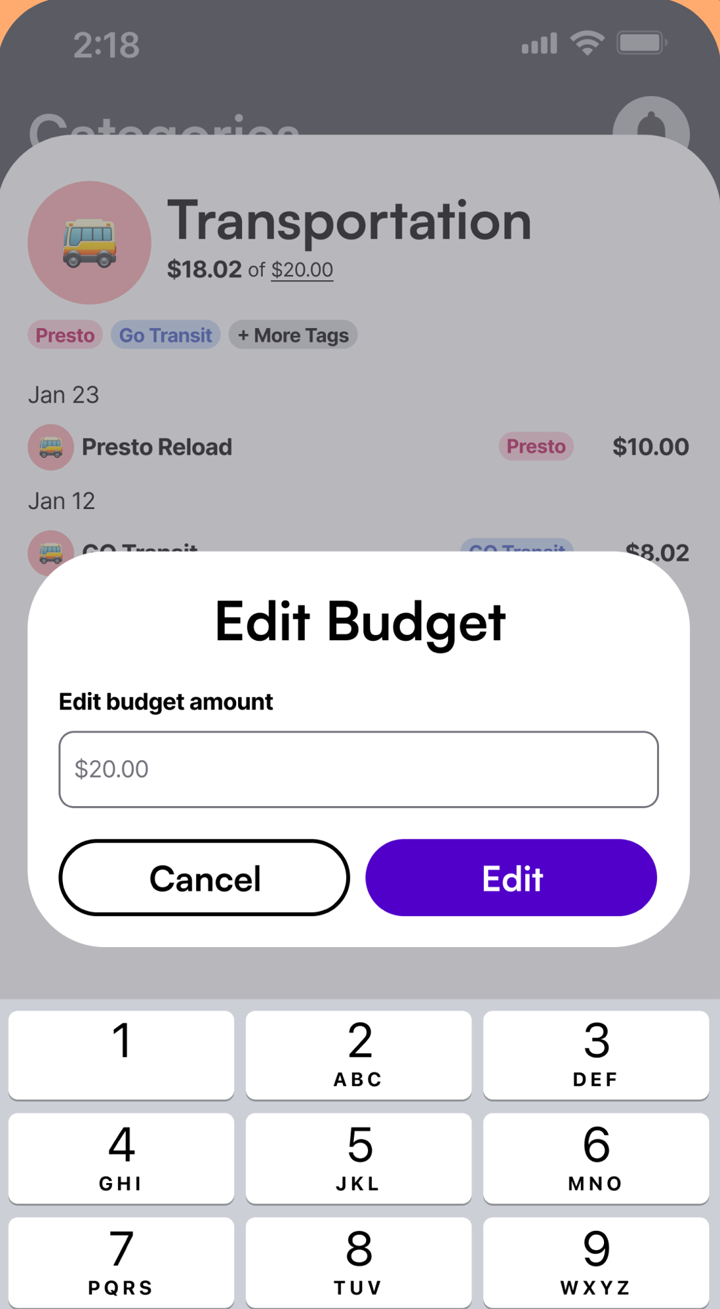
Paying off a card needs the same fixed amount every month, and Maple Budget is where you find it. Set a monthly budget for each category so you can see what’s left before payday. Add each card as a payment method so new purchases on it are easy to spot. If you move the debt to a consolidation loan, its payment can go in as a recurring transaction set to Monthly in the Loans category.
Budgeting is free. With Maple Pro ($1.99 a week, 7-day free trial) you can connect your bank so purchases fill in on their own. Maple leaves out card payments when it imports, so the payment and the purchases don’t count twice.
This is general information, not tax, legal or financial advice. Your own numbers depend on your situation, so check with the CRA or an accountant before you act.
Common Questions
Should I Pay Off My Credit Card Or Save?
Card interest is usually far higher than what savings earn, so paying down a card often comes out ahead. Many people still keep a small emergency cushion so a surprise bill doesn't go back on the card.
Is It Better To Pay Twice A Month?
Card interest is usually based on your daily balance, so paying part of it sooner can trim the interest a little. The total you pay each month matters more.
What If I Can't Make The Minimum?
Call your card issuer before you miss it. The FCAC says creditors may offer a lower rate or a longer repayment period. A non-profit credit counsellor can also help.
Will Paying Off My Card Raise My Credit Score?
Lower balances lower your credit utilization, one of the habits the FCAC lists as affecting your score. Keep the card open after you pay it off.
Sources
Every number on this page was checked against these official pages.
- Paying Off Your Credit Card (FCAC), checked November 17, 2026
- Paying Down Your Debt (FCAC), checked November 17, 2026
- Debt Consolidation (FCAC), checked November 17, 2026
- Getting Help With Debt (FCAC), checked November 17, 2026
Try It In Maple Budget
Budgeting is free on iPhone, Android and the web. One account works everywhere.