

The Minimum Payment Trap
Paying only the minimum on a credit card can take decades and cost more in interest than you borrowed. Here's why it happens and the simple fix.
Paste it into ChatGPT or Claude to ask questions about it.
Updated Facts checked SourcesView As Markdown
The minimum payment trap is what happens when you only pay the minimum on a credit card. Most of each payment goes to interest, the minimum shrinks as the balance shrinks, and the debt can take decades to clear. The Financial Consumer Agency of Canada’s own example: $2,000 at 18% with $60 minimum payments takes 3 years and 11 months and costs $793 in interest. Adding $100 a month cuts that to 1 year and 2 months and $231. The fix is to pay a fixed amount above the minimum.
What It Is
Your minimum payment is the least you can pay by the due date to keep your account in good standing. It isn’t designed to pay the card off quickly. When the minimum is a percentage of the balance, it shrinks as the balance shrinks, so payments get smaller and smaller and the last few hundred dollars hang around for years.
The FCAC says minimums are usually set one of two ways:
- A flat amount plus interest and fees. Usually $10 plus that month’s interest and fees.
- The higher of a flat amount or a percentage. Typically $10 or 3% of the balance, whichever is more.
In Quebec, the minimum has been 5% since August 1, 2025.
Key Rules
- Paying the minimum avoids a late payment, not interest. Any balance left after the due date is charged interest until it’s paid in full.
- Your statement tells you how long. Card issuers must show an estimate, in months and years, of how long it would take to pay off the balance with minimum payments only.
- More than the minimum saves a lot. The FCAC says paying more than the minimum helps you pay off your balance faster and pay less interest.
- A fixed payment beats a shrinking one. Keep paying the same amount even as the minimum drops.
- Extra money goes to the highest rate. The part of your payment above the minimum must go either to the highest-rate balance first or in proportion across balances, depending on your card.
- Use the FCAC calculator. Its credit card payment calculator compares paying the minimum, the minimum plus extra, and a fixed amount.
The FCAC's Own Example: $2,000 At 18%
| Plan | Monthly payment | Time to pay off | Interest |
|---|---|---|---|
| Minimum only | $60 | 3 years and 11 months | $793 |
| Minimum plus $100 | $160 | 1 year and 2 months | $231 |
A Worked Example
Nadia has $3,000 on a card at 20.99%. Her minimum is 3% of the balance or $10, whichever is more. She stops using the card and pays only the minimum.
In her first month, interest is about $52.48 and her minimum is about $91.57. Only about $39.09 of her payment actually lowers the balance.
We worked it out month by month with interest at the yearly rate divided by 12. Real cards charge interest daily, so real totals land a little differently.
$3,000 At 20.99%, Three Ways
Minimum only (3% or $10)Fixed $90 a monthFixed $200 a month
| Minimum only (3% or $10) | 18 years and 2 months, $3,749.71 interest |
| Fixed $90 a month | 4 years and 3 months, $1,540.55 interest |
| Fixed $200 a month | 1 year and 6 months, $510.36 interest |
Balance of $3,000 paid down over time. Minimum only (3% or $10): paid off in 18 years and 2 months with $3,749.71 of interest. Fixed $90 a month: paid off in 4 years and 3 months with $1,540.55 of interest. Fixed $200 a month: paid off in 1 year and 6 months with $510.36 of interest.
- Minimum only: 18 years and 2 months. $3,749.71 of interest. That’s more than she borrowed.
- Fixed $90 a month, about her first minimum, kept the same: 4 years and 3 months. $1,540.55 of interest.
- Fixed $200 a month: 1 year and 6 months. $510.36 of interest.
Interest Nadia Pays On $3,000
Minimum only (18 years and 2 months): $3,749.71. Fixed $90 (4 years and 3 months): $1,540.55. Fixed $200 (1 year and 6 months): $510.36.
After a full year of minimum payments, Nadia would still owe about $2,563. After five years, about $1,365.
What Nadia Still Owes On Minimum Payments
Today: $3,000. After 1 year: $2,563.01. After 5 years: $1,365.43.
The simplest fix is the middle one. Nadia doesn’t need more money than she’s paying in month one. She just needs to keep paying it.
Common Mistakes
- Letting the payment shrink. Autopay set to “minimum” lowers your payment as the balance falls. Set a fixed amount instead.
- Treating the minimum as the bill. The bill is the full balance. The minimum is the least you can pay without being late.
- Still using the card. New purchases push the balance back up and reset the clock.
- Not reading the estimate on your statement. It’s there so you can see the trap before you’re in it.
- Missing the minimum entirely. If you can’t pay more, at least pay the minimum on time. A late payment can stay on your report for up to 6 years.
How Maple Budget Helps
Escaping the trap means finding a fixed amount you can pay every month. Maple Budget is where you find it. Give each category a monthly budget and see what’s really left over after your bills.
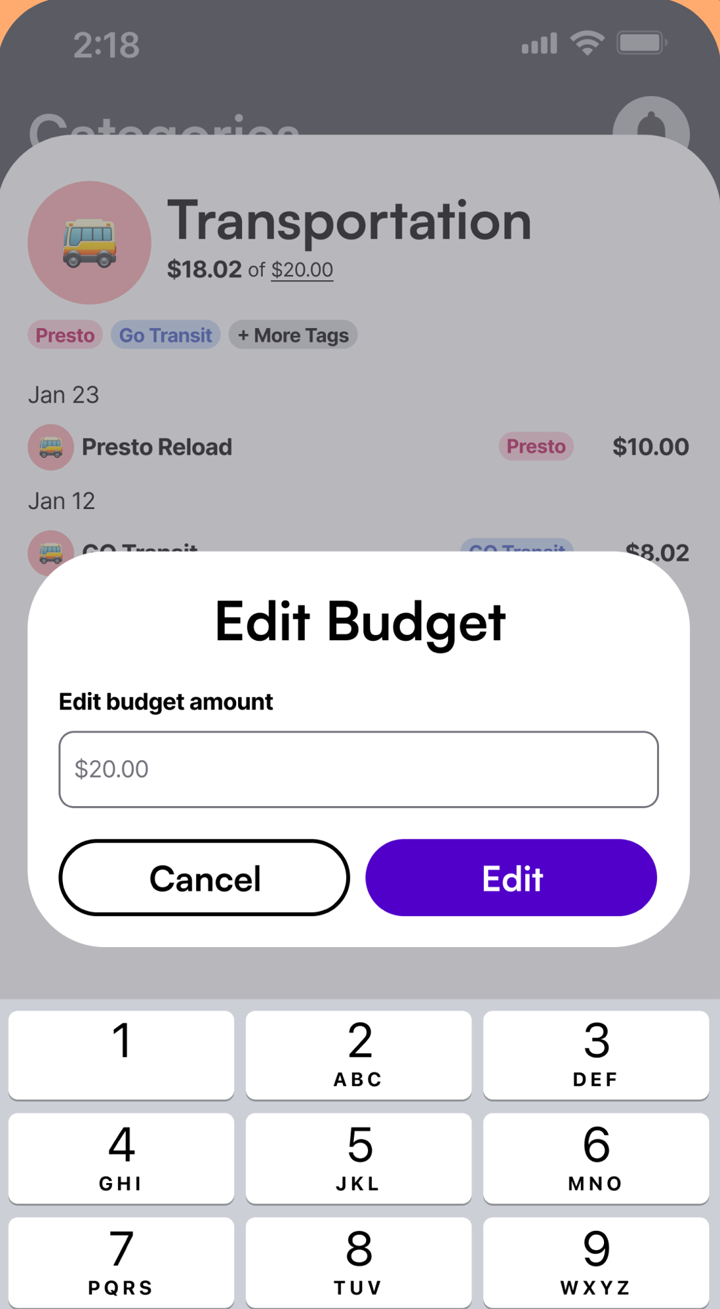
Add your card as a payment method so any new purchase on it stands out when you filter Transactions on iPhone or Android. Budgeting is free. With Maple Pro ($1.99 a week, 7-day free trial) you can connect your bank so purchases fill in on their own.
This is general information, not tax, legal or financial advice. Your own numbers depend on your situation, so check with the CRA or an accountant before you act.
Common Questions
How Is The Minimum Payment Calculated In Canada?
There's no single rule outside Quebec. The FCAC says it's usually a flat amount, often $10, plus interest and fees, or the higher of about $10 or a percentage of the balance, typically 3%. Quebec residents have a 5% minimum since August 1, 2025.
Does Paying The Minimum Hurt My Credit Score?
Paying at least the minimum on time keeps your account in good standing. But a balance that stays high keeps your credit utilization high, which can work against your score.
Where Can I See How Long The Minimum Would Take?
On your statement. Card issuers must show an estimate of how long it would take to pay the balance with minimum payments only. The FCAC also has a credit card payment calculator.
Is It Ever OK To Pay Just The Minimum?
For a month or two in a tight spot, it's far better than missing a payment. Just don't let it become the plan.
Sources
Every number on this page was checked against these official pages.
- Paying Off Your Credit Card (FCAC), checked November 17, 2026
- Financial Consumer Protection Framework Regulations, Section 66 (Justice Laws), checked November 17, 2026
- How Credit Cards Work (FCAC), checked November 17, 2026
Try It In Maple Budget
Budgeting is free on iPhone, Android and the web. One account works everywhere.