

What Is An Index Fund?
An index fund copies a market index, like the S&P/TSX Composite, instead of picking stocks. Here's how index funds work in Canada and why they cost less.
Paste it into ChatGPT or Claude to ask questions about it.
Updated Facts checked SourcesView As Markdown
An index fund is a fund that copies a market index, like the S&P/TSX Composite or the S&P 500, instead of having a manager pick investments. It holds the same securities as the index, or a close sample of them, so its value rises and falls with the index. Because nobody is picking stocks, index funds usually cost less than actively managed funds.
What It Is
An index is a list of securities that’s meant to show how part of the market is doing. The S&P/TSX Composite Index tracks the largest companies on the Toronto Stock Exchange. The S&P 500 tracks 500 large US companies. There are bond indexes too.
You can’t buy an index directly. An index fund buys what’s in the index for you. Put money in, and you own a small slice of every company on the list, in about the same proportions.
Index funds come in two forms. You can buy one as a mutual fund, from a bank or fund company, or as an ETF, through a brokerage account. The strategy is the same either way.
Indexes Canadians Often See
| Index | What it tracks |
|---|---|
| S&P/TSX Composite Index | The largest companies on the Toronto Stock Exchange |
| S&P 500 | Stocks of 500 large US companies listed on the NYSE or NASDAQ |
| FTSE TMX Canada Universe Bond Index | The Canadian investment-grade bond market |
| Dow Jones Industrial Average | 30 major US companies |
Key Rules
- It follows, it doesn’t choose. The fund aims to match its index. It doesn’t try to beat it.
- Bigger companies usually count more. Most stock indexes weight each company by its size. If one company makes up 6% of the index, it makes up about 6% of the fund.
- Some funds hold everything, some hold a sample. A fund can buy every security in its index, or a smaller set that behaves like it.
- Costs are lower. The Ontario Securities Commission says index funds tend to cost less because the manager does less research and makes fewer decisions.
- You get the index return, less fees. When the index rises 8%, the fund rises a bit less than 8%, because its MER comes out along the way.
- Diversification in one purchase. One fund can spread your money across hundreds of companies.
- Watch for leveraged and inverse funds. Some funds aim for 2x the index, or the opposite of it. They use derivatives and can behave very differently over time. They aren’t built for long-term holding.
A Worked Example
Here’s a made-up index with only three companies, to show how weighting works.
Step 1. Size up the companies. Company A is worth $600 billion, Company B $300 billion and Company C $100 billion. Together they’re worth $1 trillion.
Step 2. Work out the weights. A is 60% of the total, B is 30% and C is 10%.
Step 3. Put money in. Daniel puts $1,000 into a fund that follows this index. The fund spreads it the same way: $600 in A, $300 in B and $100 in C.
How $1,000 Spreads Across A Three-Company Index
A made-up index of three companies worth $600 billion, $300 billion and $100 billion. Their weights are 60%, 30% and 10%, so $1,000 in an index fund holds $600, $300 and $100.
Step 4. Watch the index move. Say A rises 10%, B falls 10% and C is flat. Daniel’s $600 becomes $660 and his $300 becomes $270. His $100 stays at $100. His total is $1,030, up 3%, which is what the index did before fees.
Step 5. Count the cost. A real index fund holds many more companies, but the cost math works the same way. On $25,000, an example MER of 0.25% costs $62.50 a year. An actively managed fund with an example MER of 2% costs $500 a year on the same money. The active fund has to beat the index by about 1.75% a year just to break even with the index fund.
Yearly Fees On $25,000, Index Vs Actively Managed
On $25,000, a 0.25% MER costs $62.50 a year and a 2% MER costs $500 a year.
Index Funds As The Core Of A Portfolio
Many people use a few broad index funds as the core of their portfolio. A Canadian equity index fund, a US one, an international one and a bond index fund can cover most of the world’s markets between them. Some funds combine all of these in a single fund with a set mix.
The appeal is simplicity. You don’t need to research companies or follow the news. You decide your mix, add money on a schedule and rebalance once or twice a year.
What an index fund won’t do is beat its market. You get the market’s return, less a small fee. For many investors, that’s the point.
Common Mistakes
- Thinking “index” means “safe.” An index fund still drops when its market drops. It just won’t drop because one stock picker got it wrong.
- Picking a narrow index by accident. An index of one sector, like tech or energy, is far less diversified than a broad market index.
- Holding three funds that follow nearly the same index. Two Canadian large-company funds often own the same names.
- Comparing funds on returns only. Two funds following the same index should return about the same. The cheaper one usually wins over time.
- Skipping the fund facts. Every fund has a Fund Facts or ETF Facts document. It shows the top holdings, the risk rating and the MER.
- Chasing a hot index. Switching to whatever index did best last year is stock picking by another name.
How Maple Budget Helps
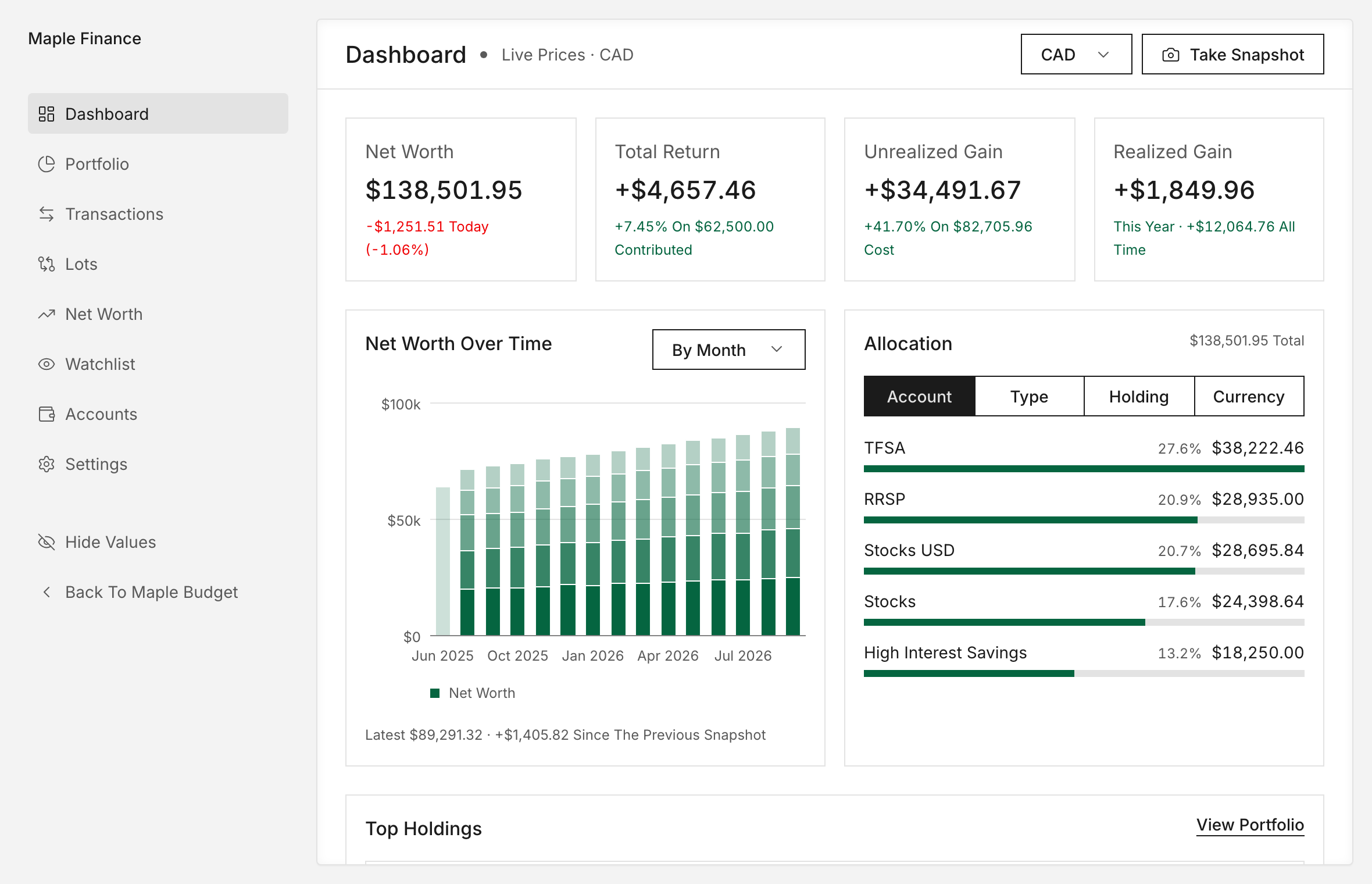
Add your index funds to Maple Finance with their tickers, and Maple prices them live. The Allocation card on the Dashboard shows how your money splits by holding, account, account type or currency. If you hold a Canadian index fund and a US one, you can see the balance between them at a glance.
The Total Return tile shows how your portfolio has done against what you put in, so you can check whether you’re getting roughly what the index delivered. Set this up with add your investments.
Maple Finance comes with Maple Pro, which starts with a 7-day free trial.
This is general information, not tax, legal or financial advice. Your own numbers depend on your situation, so check with the CRA or an accountant before you act.
Common Questions
Is An Index Fund The Same As An ETF?
Not quite. An index fund is a strategy: follow an index. It can come as a mutual fund or as an ETF. Most ETFs are index funds, but some ETFs are actively managed.
Can An Index Fund Lose Money?
Yes. An index fund goes up and down with its index. If the S&P/TSX Composite falls 20%, a fund that follows it falls about the same, minus its fees.
Why Are Index Funds Cheaper?
The manager follows a list instead of researching and choosing stocks. Less research and fewer decisions mean lower costs, which shows up as a lower MER.
Will An Index Fund Match The Index Exactly?
Close, but not exactly. Fees come out of the fund, and some funds hold a sample of the index rather than every security, so the return lands a little below the index.
Sources
Every number on this page was checked against these official pages.
- How Market Indexes Can Help You Build Your Strategy (Ontario Securities Commission, GetSmarterAboutMoney.ca), checked November 17, 2026
- Mutual Fund Fees (Ontario Securities Commission, GetSmarterAboutMoney.ca), checked November 17, 2026
- How Exchange-Traded Funds (ETFs) Work (Ontario Securities Commission, GetSmarterAboutMoney.ca), checked November 17, 2026
- Understanding Fund Facts (Ontario Securities Commission, GetSmarterAboutMoney.ca), checked November 17, 2026
Try It In Maple Budget
Budgeting is free on iPhone, Android and the web. One account works everywhere.