

How A TFSA Works In Canada
A TFSA lets your savings and investments grow tax-free. Here's who can open one, the 2026 limit, how withdrawals work and the mistakes that cost money.
Paste it into ChatGPT or Claude to ask questions about it.
Updated Facts checked SourcesView As Markdown
A Tax-Free Savings Account is the most flexible account most Canadians have. Money you put in grows without tax, and you can take it out any time without tax. The catch is the limit. Go over it and the CRA charges you every month.
What It Is
A TFSA is a registered account you open at a bank, credit union or brokerage. You put in money you’ve already paid tax on. Anything it earns inside the account, like interest, dividends or a rise in a stock’s price, is not taxed. When you take money out, that isn’t taxed either.
The name says “savings”, but a TFSA can hold investments too. It can be a high-interest savings account, a GIC, or a brokerage account full of stocks and ETFs. The tax rules are the same either way.
Tax At Each Stage Of A TFSA
- Putting money inYou use money you've already paid tax on. Nothing comes off your taxes.No deduction
- While it growsInterest, dividends and gains aren't taxed and don't use up room.Not taxed
- Taking money outAny time, for any reason. The amount comes back as room next January 1.Not taxed
Key Rules
- Who can open one. You need to be a resident of Canada, at least 18, and have a valid Social Insurance Number. Some provinces set the age of majority at 19, so you may need to wait a year to open the account, but room still builds from 18.
- The 2026 limit is $7,000. The CRA adds the year’s dollar limit to your room on January 1.
- Unused room carries forward. If you don’t use your room, it waits for you. Someone who has been eligible since 2009 and never contributed has $109,000 of room in 2026.
- Contributions aren’t deductible. Unlike an RRSP, putting money in doesn’t lower your tax.
- Growth isn’t taxed. Earnings inside the account don’t use up room and aren’t taxed.
- Withdrawals come back next year. When you take money out, the same amount is added back to your room on January 1 of the following year, not right away.
- Going over costs 1% a month. An over-contribution is taxed at 1% per month for as long as it stays in.
- What it can hold. Cash, mutual funds, securities listed on a designated stock exchange, GICs, bonds and certain shares of small business corporations.
Can You Open A TFSA?
- Are you a resident of Canada?NoYou can't open one yetYes
- Are you at least 18?NoNot yetRoom starts building the year you turn 18Yes
- Do you have a valid Social Insurance Number?NoGet a SIN firstYes
- You can open a TFSAAt a bank, credit union or brokerage
A Worked Example
Jordan turned 18 in 2021 and has lived in Canada the whole time. Jordan has never had a TFSA. Here’s the room Jordan has in 2026, one year at a time.
| Year | TFSA Dollar Limit |
|---|---|
| 2021 | $6,000 |
| 2022 | $6,000 |
| 2023 | $6,500 |
| 2024 | $7,000 |
| 2025 | $7,000 |
| 2026 | $7,000 |
| Total | $39,500 |
How Jordan's $39,500 Builds Up
Jordan's TFSA room adds the yearly limit for each year from 2021 to 2026: 2021 $6,000, 2022 $6,000, 2023 $6,500, 2024 $7,000, 2025 $7,000, 2026 $7,000. Together they come to $39,500.
In February 2026, Jordan opens a TFSA and puts in $20,000. Room left for 2026 is $39,500 minus $20,000, which is $19,500.
In August, Jordan’s car needs a $4,000 repair, so Jordan takes $4,000 out. That withdrawal is not taxed. But it doesn’t give room back yet. Room for the rest of 2026 is still $19,500.
On January 1, 2027, the CRA adds two things to Jordan’s room: the $4,000 withdrawal and whatever the 2027 dollar limit turns out to be.
Jordan's TFSA Room Through 2026
RoomWithdrawal added back
Jordan starts 2026 with $39,500 of TFSA room. After putting in $20,000 in February, room is $19,500. Taking out $4,000 in August leaves room at $19,500. On January 1, 2027 the $4,000 is added back, along with the 2027 dollar limit.
Now say Jordan had already used every dollar of room, and put the $4,000 back in October 2026. That $4,000 would be an over-contribution. At 1% a month, it costs $40 for each month it stays in. Left in from October to December, that’s $120 of tax for no reason. Waiting until January would have cost nothing.
Putting $4,000 Back Too Soon
If Jordan has no room and puts the $4,000 back in October 2026, the over-contribution costs $40 a month for October, November and December, $120 in total. Waiting until January 1, 2027 costs $0.
Growth works in Jordan’s favour too. Say the $16,000 still in the account is invested and grows to $22,000 over a few years. The $6,000 of growth is not taxed, and it doesn’t use any room. If Jordan later takes out the whole $22,000, the full $22,000 is added back to Jordan’s room the next January 1. That’s more than Jordan ever put in. This is one of the quiet advantages of a TFSA over a regular account.
Growth Comes Back As Room
Put inGrowthRoom added back
Jordan's $16,000 grows to $22,000, including $6,000 of tax-free growth. If Jordan takes out the full $22,000, $22,000 is added back to Jordan's room on the next January 1.
Common Mistakes
- Putting a withdrawal back in the same year. This is the most common way people go over. The room comes back next January, not when you take the money out.
- Trusting the CRA number in the middle of the year. CRA My Account shows your room as of January 1. This year’s contributions and withdrawals only show up there the following year. Keep your own count for the current year.
- Forgetting about a second TFSA. Room is per person, not per account. Two TFSAs at two banks share the same room.
- Leaving it all in cash for years. A TFSA in a savings account is fine for an emergency fund. For long-term money, the tax-free part matters most when the money can grow.
How Maple Budget Helps
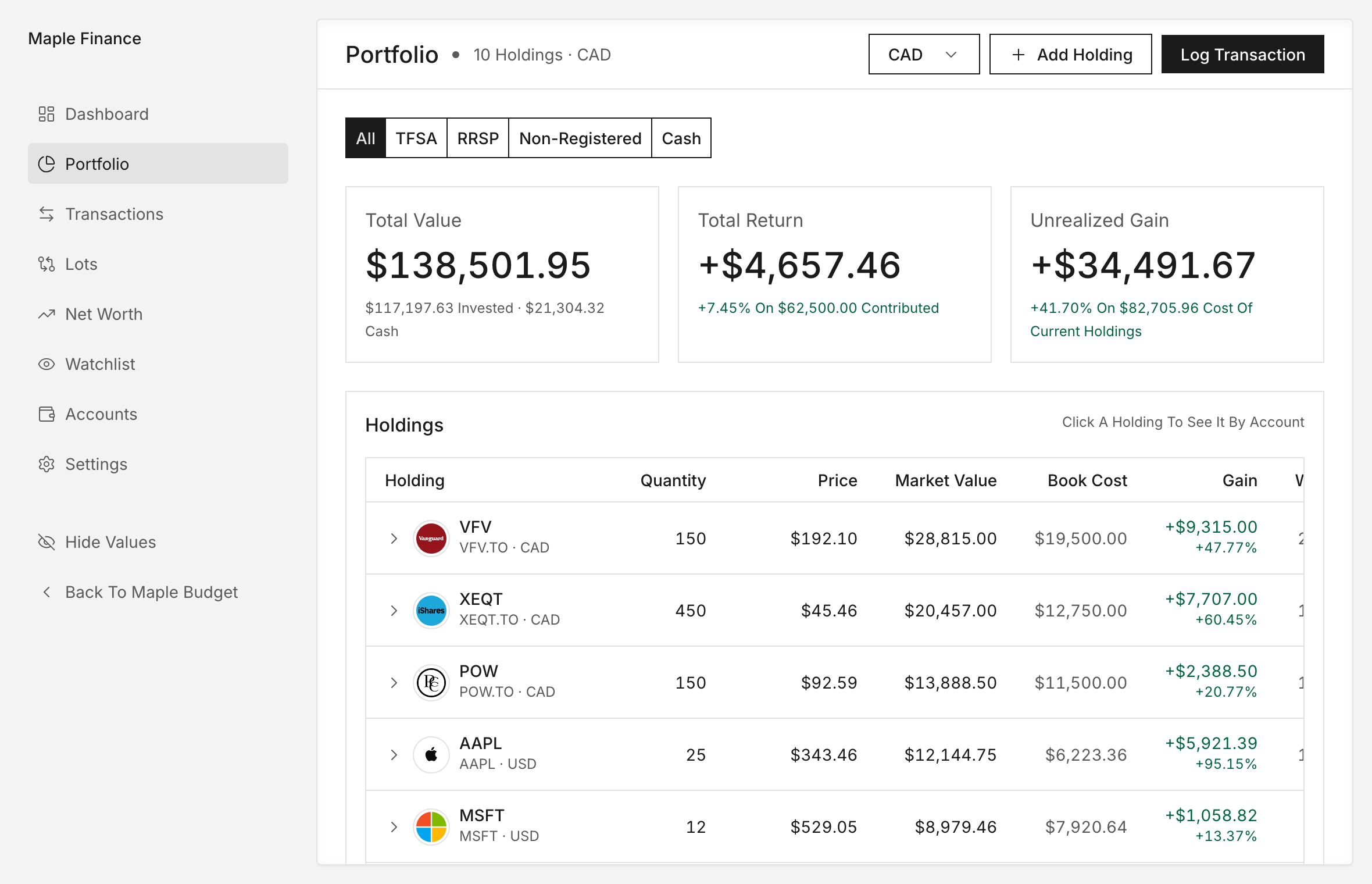
Maple Budget keeps your TFSA next to the rest of your money. In Maple Finance, add your TFSA as an account and track what it holds, with live prices and your total return. You can follow the steps in add your investments.
The Taxes page on the web keeps count of your room for you. Type in the TFSA room from your Notice of Assessment, then log each contribution and withdrawal as you make it. Maple shows what’s left, says Full when you’ve used it all, and shows Over with the monthly penalty if you go past it. TFSA withdrawals come back as room on January 1 of the next year, the same way the CRA counts them. The steps are in track your TFSA, RRSP and FHSA room.
Maple Finance comes with Maple Pro, which starts with a 7-day free trial. Budgeting is free.
This is general information, not tax, legal or financial advice. Your own numbers depend on your situation, so check with the CRA or an accountant before you act.
Common Questions
Is TFSA Money Taxed When I Take It Out?
No. Withdrawals from a TFSA are not taxed, and neither is the interest, dividends or growth earned inside it. You also don't get a tax deduction when you put money in.
What Is The TFSA Limit For 2026?
The TFSA dollar limit for 2026 is $7,000. It's added to your room on January 1. Unused room from past years carries forward, so your total room can be much higher. See TFSA contribution room for how to work it out.
Can I Put Money Back After I Take It Out?
Yes, but the room comes back on January 1 of the next year. If you put it back in the same year and have no other room, it counts as an over-contribution and the CRA charges 1% a month on the excess.
Can I Have More Than One TFSA?
Yes. You can hold TFSAs at more than one bank or brokerage. Your contribution room is shared across all of them, so add them up before you contribute.
Sources
Every number on this page was checked against these official pages.
- Calculate Your TFSA Contribution Room (CRA), checked November 16, 2026
- Before You Contribute To A TFSA (CRA), checked November 16, 2026
- Opening A TFSA (CRA), checked November 16, 2026
- Types Of Investments In A TFSA (CRA), checked November 16, 2026
- Help With The TFSA Contribution Page In My Account (CRA), checked November 16, 2026
- MP, DB, RRSP, DPSP, ALDA, TFSA Limits And YMPE (CRA), checked November 16, 2026
Try It In Maple Budget
Budgeting is free on iPhone, Android and the web. One account works everywhere.