

How ETFs Work
An ETF is a fund that trades on a stock exchange like a single stock. Here's how ETFs work in Canada, what they cost and how they differ from mutual funds.
Paste it into ChatGPT or Claude to ask questions about it.
Updated Facts checked SourcesView As Markdown
An ETF, or exchange-traded fund, is a fund that holds a basket of investments, like stocks or bonds, and trades on a stock exchange like a single stock. When you buy one unit, you own a small slice of everything the fund holds. The price moves all day while the market is open, and the fund charges a yearly fee called the MER.
What It Is
An ETF is a collection of investments owned by a group of investors and run by a professional money manager. That’s the same idea as a mutual fund. The difference is how you buy it. You buy ETF units through a brokerage account, on an exchange like the Toronto Stock Exchange, at whatever the price is when your order fills.
You don’t own the stocks inside the fund directly. You own units of the fund, and the fund owns the stocks. If the investments inside go up, the unit price usually goes up too.
Most ETFs are index funds. They follow a market index, like the S&P/TSX Composite, instead of having a manager pick stocks. That tends to keep costs low. Some ETFs are actively managed, and some use borrowing or derivatives to multiply returns. Those usually cost more and carry more risk.
What Happens When You Buy An ETF
- 1You place an orderYou buy units on a stock exchange through a brokerage account, at the price during the trading day.
- 2The fund holds the investmentsA professional money manager runs the fund, which holds a basket of stocks, bonds or both.
- 3Returns come back two waysThe unit price can rise or fall, and some ETFs pay out interest, dividends or capital gains as distributions.
- 4Costs come out along the wayThe MER comes out of the fund every year, and your broker may charge a commission on each trade.
Key Rules
- It trades like a stock. An ETF has a ticker symbol and trades during market hours. The price can change through the day, and it can be a little different from the value of what the fund holds.
- There’s no set minimum. You can buy a single unit. The least you need is usually the price of one unit plus any commission.
- You make money two ways. The unit price can rise, and some ETFs pay out the interest, dividends or capital gains they earn. These payouts are called distributions.
- Distributions don’t reinvest by themselves. Many mutual funds reinvest automatically. With an ETF, the cash lands in your account unless you set up a reinvestment plan with your broker.
- There are two main costs. The management expense ratio, or MER, comes out of the fund every year. Your broker may also charge a commission each time you buy or sell. Frequent trading makes commissions add up.
- ETF MERs are usually lower. The Ontario Securities Commission says ETF MERs are usually lower than mutual funds in the same class. Mutual fund MERs range from under 1% to over 3%.
- Holdings are public. Most ETFs publish what they hold every day, so you can see exactly what you own.
- Taxes depend on the account. In a TFSA, growth and distributions are tax-free. In a non-registered account, distributions are taxable and selling at a profit is a capital gain.
ETFs And Mutual Funds, Side By Side
| ETF | Mutual fund | |
|---|---|---|
| Where you buy | On a stock exchange, through a brokerage account | From the fund company or a dealer |
| Price | Changes all through the trading day | Set once a day |
| Ticker symbol | Yes, like a stock | No, a fund code |
| Distributions | Not reinvested automatically | Often reinvested automatically |
| Typical fees | Usually a lower MER, plus any trading commission | MER from under 1% to over 3% |
A Worked Example
Priya lives in Toronto and wants to start investing in her TFSA. She picks a broad Canadian equity ETF that follows an index of large Canadian companies. In this example, the units cost $35 each and the MER is 0.20%.
Step 1. Buy units. She puts in a limit order for 20 units at $35. Her order fills, and she pays $700. Her broker charges no commission on ETF purchases, so that’s her full cost.
Step 2. Work out the yearly fee. 0.20% of $700 is $1.40 a year. She never sees a bill for it. The fund takes it out a little at a time, which lowers the return she sees.
Step 3. Compare it with a costlier fund. If she had $10,000 in a fund with a 2% MER, the fee would be $200 a year. At 0.20% it would be $20. Same money, ten times the cost.
Yearly Cost Of $10,000 At Different MERs
On $10,000, an MER of 0.20% costs $20 a year, 1% costs $100 and 2% costs $200.
Step 4. Get a distribution. A few months later, the ETF pays a distribution, and some cash shows up in her TFSA. It doesn’t buy more units on its own. She uses it the next time she adds money.
Because it’s a TFSA, Priya won’t pay tax on the distribution or on any gain when she sells.
Common Mistakes
- Using market orders when markets are quiet. A market order fills at whatever price is there. A limit order sets the most you’ll pay, which matters for ETFs that don’t trade much.
- Picking on past returns alone. Last year’s top ETF is often a narrow bet. Read what it holds and what it costs first.
- Ignoring the MER because it’s small. A 1.8% gap in fees every year adds up to a big gap over decades. See MER fees and why they matter.
- Buying leveraged ETFs for the long term. Funds that aim for 2x or inverse returns use derivatives and can behave very differently from the index over time.
- Letting cash pile up. Distributions sit as cash unless you reinvest them. Check your account every few months.
- Overlapping funds. Two Canadian equity ETFs often hold the same big companies. More funds doesn’t always mean more diversification.
How Maple Budget Helps
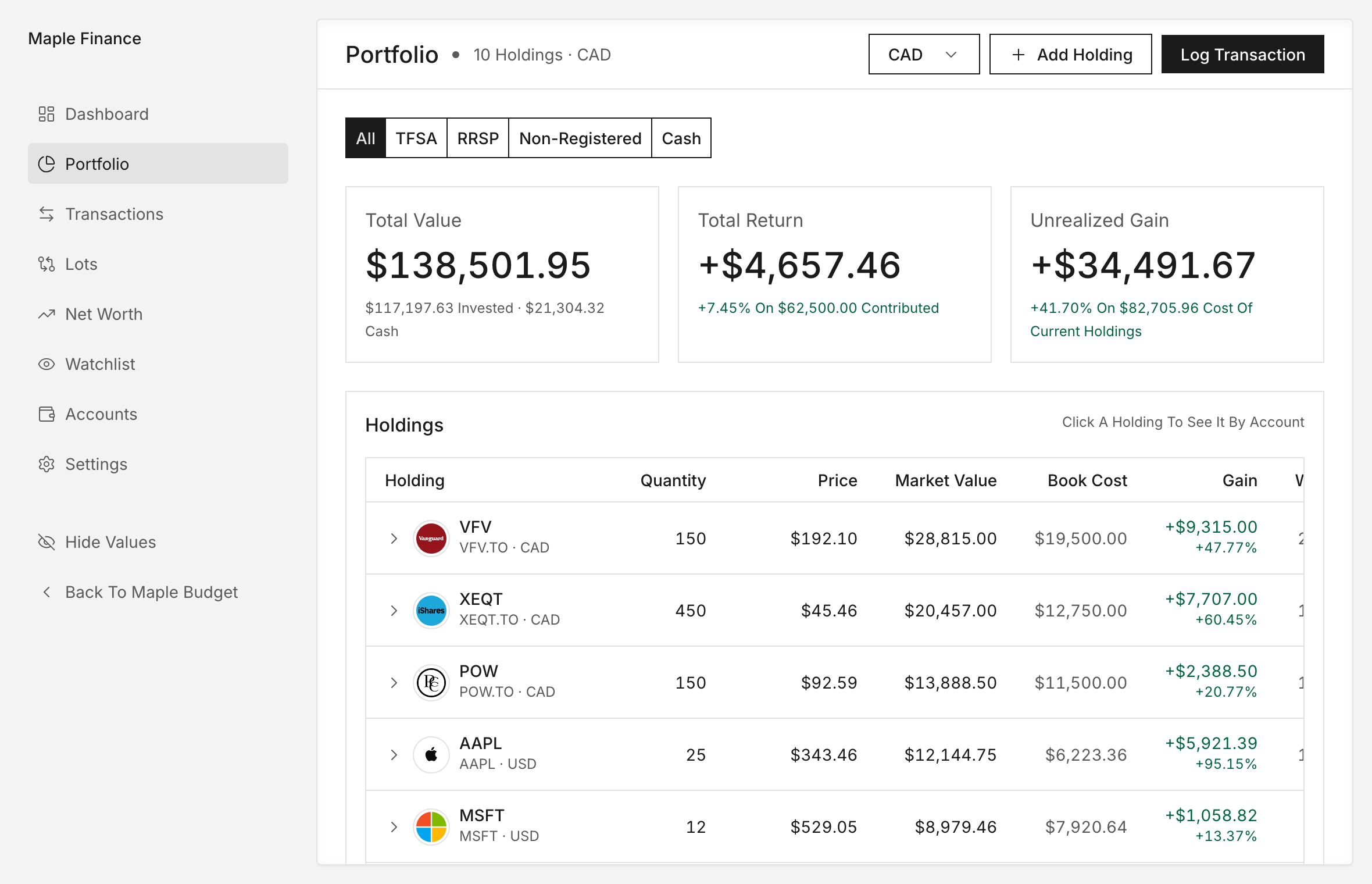
In Maple Finance, add your ETFs as holdings in the accounts you hold them in, like a TFSA, RRSP or non-registered account. Type the ticker, like XEQT.TO, and Maple pulls a live price for Canadian, US and UK listings. You can also log each buy and sell as a trade, and include any commission in the total you paid. The steps are in add your investments.
The Dashboard shows your Net Worth, Total Return, Unrealized Gain and Realized Gain. The Allocation card splits everything by account, account type, holding or currency, so you can see how much is in each ETF.
Maple doesn’t track MERs or distributions yet. Look those up in the fund’s ETF Facts document. Maple Finance comes with Maple Pro, which starts with a 7-day free trial. Budgeting stays free.
This is general information, not tax, legal or financial advice. Your own numbers depend on your situation, so check with the CRA or an accountant before you act.
Common Questions
Is An ETF Safer Than A Stock?
A broad ETF spreads your money across many companies, so one company doing badly hurts less. It can still lose value when the whole market falls. A narrow or leveraged ETF can swing as much as a single stock, or more.
Do ETFs Pay Dividends?
Some do. An ETF can pass on the interest, dividends or capital gains it earns as distributions. Unlike many mutual funds, an ETF does not reinvest them for you automatically. Some brokers offer a plan that does.
Can I Hold ETFs In A TFSA Or RRSP?
Yes. The CRA lists securities on a designated stock exchange, which includes ETFs on the TSX, among the investments a TFSA can hold. RRSPs commonly hold them too. Growth inside a TFSA is tax-free.
What Is The Minimum To Buy An ETF?
There is no set minimum investment. You buy whole units at the market price, so the price of one unit is usually the least you need, plus any commission your broker charges.
Sources
Every number on this page was checked against these official pages.
- How Exchange-Traded Funds (ETFs) Work (Ontario Securities Commission, GetSmarterAboutMoney.ca), checked November 17, 2026
- Mutual Fund Fees (Ontario Securities Commission, GetSmarterAboutMoney.ca), checked November 17, 2026
- How Market Indexes Can Help You Build Your Strategy (Ontario Securities Commission, GetSmarterAboutMoney.ca), checked November 17, 2026
- Types Of Investments For A TFSA (CRA), checked November 17, 2026
- Basics Of Investing (Financial Consumer Agency Of Canada), checked November 17, 2026
Try It In Maple Budget
Budgeting is free on iPhone, Android and the web. One account works everywhere.