

Dollar-Cost Averaging
Dollar-cost averaging means investing a fixed amount on a schedule, no matter the price. Here's how it works in Canada, with a worked example and its trade-offs.
Paste it into ChatGPT or Claude to ask questions about it.
Updated Facts checked SourcesView As Markdown
Dollar-cost averaging means investing the same amount of money on a regular schedule, like $400 every month, no matter what the price is. When prices are low, your money buys more units. When prices are high, it buys fewer. Over time, your average cost evens out, and you never have to guess the right day to invest.
What It Is
The Ontario Securities Commission describes it simply. If you invest $1,000 each month instead of $12,000 at one time, you’re dollar-cost averaging at monthly intervals. The overall cost of your investment averages out as you buy at higher and lower prices.
For most people, this isn’t really a strategy they choose. It’s what happens when you invest part of every paycheque. You don’t have a pile of cash waiting. You have money coming in each month, so you invest it each month.
Key Rules
- Same amount, same schedule. Pick a dollar amount and a frequency, like weekly or monthly, and stick to both.
- You buy more when prices are low. A fixed amount buys more units at a lower price. That pulls your average cost down.
- It isn’t market timing. The point is to stop trying to pick the best day. The Ontario Securities Commission lists this as its main advantage.
- It fits a budget. Investing a set amount each month is easy to plan around, the same as rent or a phone bill.
- Trading costs can add up. More purchases mean more trades. If your broker charges a commission, a small monthly amount can lose a big share to fees.
- You might miss an early rise. If you have the full amount today and prices go up, the money you hold back buys at higher prices later.
- Your ACB is the average. In a non-registered account, the CRA has you use the average cost of identical shares for your adjusted cost base. Every purchase changes it.
A Worked Example
Maya invests $400 on the first of every month into the same ETF in her TFSA. Her broker charges no commission. The price moves around over four months.
| Month | Price | Units bought |
|---|---|---|
| Month 1 | $20 | 20 |
| Month 2 | $16 | 25 |
| Month 3 | $25 | 16 |
| Month 4 | $20 | 20 |
| Total | 81 |
Maya Invests $400 A Month For Four Months
Unit prices by month: $20, $16, $25 and $20. Her $400 buys 20, 25, 16 and 20 units.
Step 1. Add up what she put in. Four months at $400 is $1,600.
Step 2. Add up what she owns. 20 plus 25 plus 16 plus 20 is 81 units.
Step 3. Work out her average cost. $1,600 divided by 81 units is about $19.75 a unit.
Step 4. Compare with the average price. The four prices were $20, $16, $25 and $20. Their average is $20.25.
Maya paid about 50 cents a unit less than the average price. That happened because her $400 bought the most units in month 2, when the price was lowest. She didn’t have to know month 2 would be the low point.
Average Price Vs What Maya Actually Paid
The average of the four prices is $20.25. Her average cost per unit is $1,600 divided by 81 units, about $19.75.
Step 5. Check the value. At the end of month 4, 81 units at $20 are worth $1,620. She’s up $20 even though the price ended exactly where it started.
That small win isn’t guaranteed. If the price had climbed every month, she’d have bought fewer and fewer units, and a lump sum on day one would have done better.
Dollar-Cost Averaging Vs Investing All At Once
| All at once | Bit by bit | |
|---|---|---|
| When your money is invested | Right away | Over weeks or months |
| If prices rise after you start | More of your money catches the rise | Later buys cost more |
| If prices fall after you start | All of it takes the drop | Later buys cost less |
| Timing the market | One decision about when | No timing, just a schedule |
| Trading costs | One trade | More trades, so more commissions if your broker charges them |
What If You Have A Lump Sum?
Say you get a $12,000 bonus or inheritance. You could invest it all today, or spread it out, say $1,000 a month for 12 months. The Ontario Securities Commission notes that spreading it out means you could miss out on an early opportunity.
There’s no wrong answer, only a trade-off. Investing it all at once gets your money working sooner. Spreading it over a few months lowers the chance of putting everything in just before a drop, which can make it easier to stick with your plan.
If you choose to spread it out, set the schedule in advance and keep to it. Changing the plan each month based on the news turns it back into market timing.
Common Mistakes
- Stopping when prices fall. A drop is when a fixed amount buys the most. Pausing then gives up the main benefit. See what to do when the market drops.
- Paying a commission on tiny trades. A $9.95 commission on a $50 purchase is almost 20%. If your broker charges per trade, invest less often in bigger amounts.
- Holding a lump sum back for years. Spreading an inheritance over a few months is a comfort choice. Spreading it over five years leaves most of it in cash.
- Using it on a single risky stock. Averaging into one company that keeps falling just buys more of a falling company. It works best with diversified funds.
- Forgetting the ACB in a non-registered account. Every monthly purchase changes your average cost. Keep the records, or use a tool that keeps them.
How Maple Budget Helps
In Maple Budget, set up a recurring transaction for your monthly investment, in the Investments category, and give that category a monthly budget. Your budget then shows the money going to investing each month, next to rent and groceries. Recurring transactions and budgets are free.
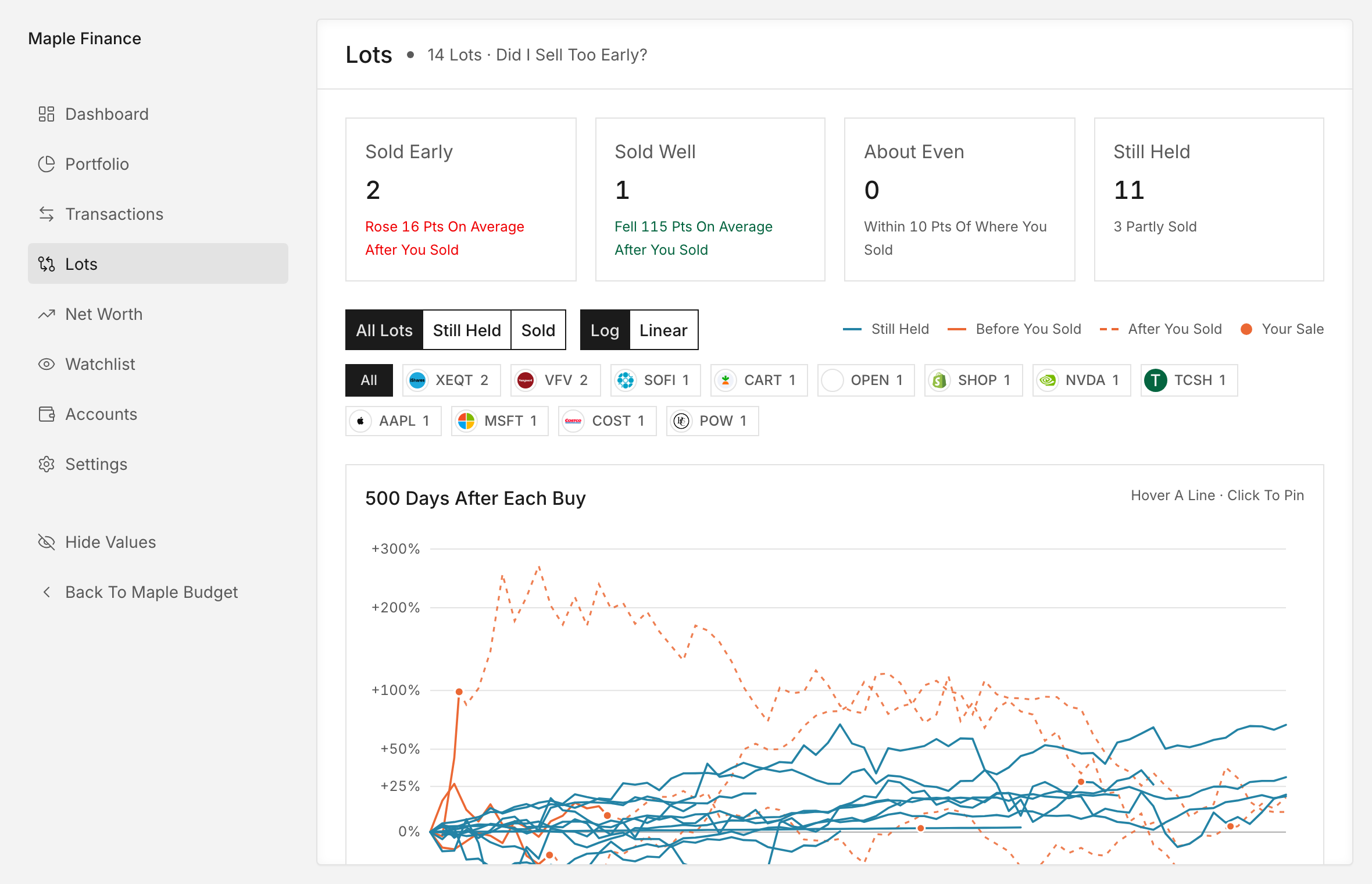
In Maple Finance, log each purchase as a buy. Maple keeps your average cost as you go, so your adjusted cost base stays right without a spreadsheet. On the web, the Lots page follows each buy separately, so you can see how each month’s purchase has done. Maple Finance comes with Maple Pro, which starts with a 7-day free trial.
This is general information, not tax, legal or financial advice. Your own numbers depend on your situation, so check with the CRA or an accountant before you act.
Common Questions
Is Dollar-Cost Averaging Better Than Investing A Lump Sum?
Not always. If prices rise after you start, a lump sum invested on day one usually ends up ahead. Dollar-cost averaging helps most when prices dip along the way, and it takes the stress out of picking a day.
How Often Should I Invest?
Whatever matches your pay. Many people invest each payday or once a month. The Ontario Securities Commission gives weekly or monthly as examples. What matters most is keeping the schedule.
Does Dollar-Cost Averaging Protect Me From Losses?
No. If the investment keeps falling, every purchase loses value. It lowers the risk of putting everything in at a bad moment, but it doesn't stop the market from going down.
Sources
Every number on this page was checked against these official pages.
- How Can You Make Money From Investing? (Ontario Securities Commission, GetSmarterAboutMoney.ca), checked November 17, 2026
- How Does Market Volatility Affect Your Investments? (Ontario Securities Commission, GetSmarterAboutMoney.ca), checked November 17, 2026
- Capital Gains 2025, Guide T4037 (CRA), checked November 17, 2026
Try It In Maple Budget
Budgeting is free on iPhone, Android and the web. One account works everywhere.