

What Is A Stock?
A stock, or share, is a small piece of ownership in a company. Here's how stocks work in Canada, how you make or lose money and how common and preferred shares differ.
Paste it into ChatGPT or Claude to ask questions about it.
Updated Facts checked SourcesView As Markdown
A stock, also called a share, is a small piece of ownership in a company. If you own shares, you own part of the business. You make money if the share price goes up and you sell, or if the company pays you dividends. You lose money if the price falls below what you paid. Nothing about the return is guaranteed.
What It Is
Companies sell shares to raise money. In return, the people who buy them own part of the company. A large public company can have tens of millions of shares or more, owned by people all over the world.
Stocks trade on stock exchanges. The Toronto Stock Exchange is Canada’s largest. Buyers and sellers meet there through their brokers, and the price moves with supply and demand.
The first sale happens when a private company sells shares to the public in an initial public offering, or IPO. That’s the primary market, and the money goes to the company. After that, investors trade the shares with each other in the secondary market. When you buy shares through your broker, you’re almost always buying them from another investor.
How A Share Gets From A Company To You
- 1The company sells sharesIn an initial public offering, a private company makes shares available to the public. This is the primary market.
- 2Shares list on an exchangeIn Canada, the Toronto Stock Exchange is the largest.
- 3Investors trade with each otherThis is the secondary market. Prices move with supply and demand.
- 4You buy through a brokerYour brokerage account places the order for you.
Key Rules
- You own part of the company. A share is part ownership. Common shareholders usually get a vote on some business decisions.
- Two ways to make money. A capital gain if you sell for more than you paid, and dividends if the company pays them.
- Two ways to lose money. The price can fall, and dividends can be cut. If you sell below your cost, you have a capital loss.
- Most shares are common shares. They can grow and pay rising dividends, but they swing more and are paid last if the company is wound up.
- Preferred shares are steadier. They usually pay a fixed dividend, ahead of common shareholders, but usually have no vote.
- Prices move for many reasons. Company results, industry news, investor mood, interest rates, inflation and the economy all play a part.
- Some stocks swing more than others. A beta above 1.0 means a stock has moved more than the market. Below 1.0 means less.
- Tax depends on the account. In a non-registered account, half of a capital gain is taxable. In a TFSA, gains are tax-free.
A Worked Example
Sam opens a non-registered account in Toronto and buys 100 shares of a Canadian company at $50 each.
Step 1. Work out his stake. He pays $5,000. If the company has 100 million shares, his 100 shares are 0.0001% of it. Small, but he’s an owner.
Step 2. Collect dividends. Over two years, the company pays $1.00 a share in dividends in total. Sam receives $200.
Step 3. Sell. The price rises to $60, and he sells all 100 shares for $6,000. Ignoring commissions, his capital gain is $1,000.
Step 4. Add it up. He made $1,000 from the price and $200 from dividends, $1,200 on $5,000. That’s 24% over two years.
Sam's Return On 100 Shares
Sam buys 100 shares at $50 for $5,000 and sells at $60 for $6,000, a $1,000 price gain. He also received $200 of dividends.
Step 5. Picture the other side. If the price had fallen to $40 instead, selling would have meant a $1,000 capital loss. The $200 of dividends would have softened it, but he’d still be down $800.
Step 6. Think about tax. In his non-registered account, half of the $1,000 gain, or $500, is added to his income. The $200 of dividends is taxable too, with the dividend tax credit. In a TFSA, none of it would be taxed.
Common And Preferred Shares
| Common | Preferred | |
|---|---|---|
| Dividends | Not guaranteed, can grow or be cut | Usually fixed, paid before common |
| Voting rights | Usually yes | Usually no |
| Price swings | Larger | Smaller |
| If the company is wound up | Paid last | Paid before common shareholders |
Stocks Through Funds
You don’t have to pick individual companies to own stocks. An equity ETF or mutual fund holds many stocks for you. A broad Canadian index fund owns slices of the largest companies on the Toronto Stock Exchange. A US one can own 500 large US companies through the S&P 500.
That changes the risk. One company can lose most of its value. A fund holding hundreds of companies is far less exposed to any one of them, though it still falls when the whole market falls.
Many investors do both. They hold most of their money in broad funds and a small part in individual stocks they want to follow. If you do that, keep the single-stock part to an amount you could lose without changing your plans.
Common Mistakes
- Putting everything in one stock. One company can fall a long way. A broad ETF spreads the risk across many.
- Buying because the price went up. A rising price says nothing about whether it will keep rising.
- Treating a low price as cheap. A $5 share isn’t cheaper than a $500 one. What matters is the value of the business behind it.
- Forgetting commissions and currency. Fees and exchange rates change your real cost, especially on US stocks.
- Selling in a panic. Prices swing. Selling after a drop turns a paper loss into a real one.
- Not tracking your cost. In a non-registered account, you need your adjusted cost base to report a gain or loss.
How Maple Budget Helps
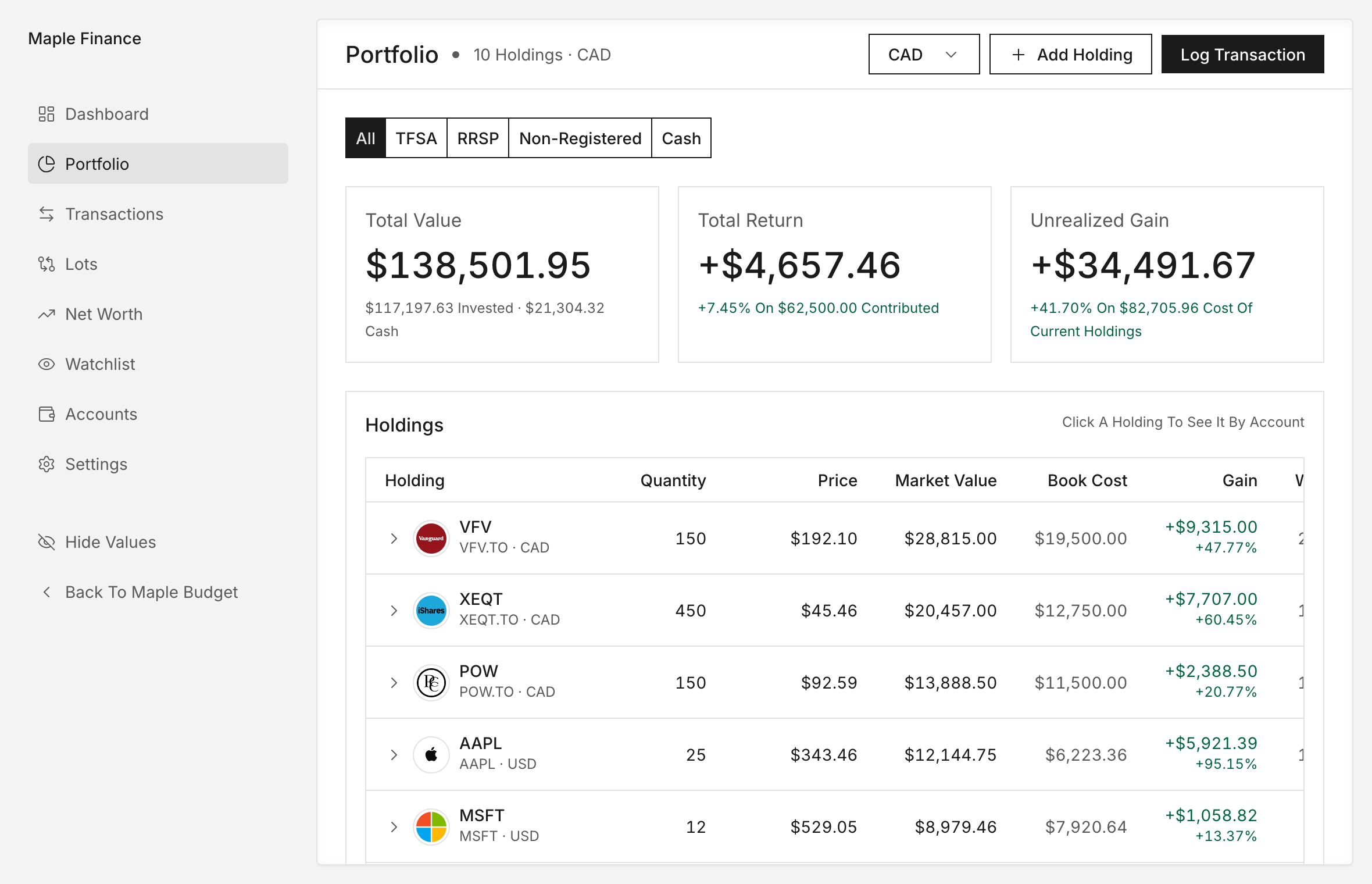
Add your stocks to Maple Finance with their tickers, and Maple prices them live for Canadian, US and UK listings. The Portfolio page shows each holding with its value and gain. Log your buys and sells, and Maple keeps your average cost and your realized gain for the year. See add your investments.
Thinking about a stock? Add it to your Watchlist to follow its price before you buy. Maple Finance comes with Maple Pro, which starts with a 7-day free trial.
This is general information, not tax, legal or financial advice. Your own numbers depend on your situation, so check with the CRA or an accountant before you act.
Common Questions
What Is The Difference Between A Stock And A Share?
In everyday use, they mean the same thing. A share is one unit of ownership. People say they own stock in a company, or own 100 shares of it.
Can I Lose More Than I Put Into A Stock?
Not when you buy with your own cash. The most you can lose is what you paid, if the share price falls to zero. Borrowing to invest, like buying on margin, adds risk because you owe the loan back either way.
Do I Get A Say In How The Company Is Run?
Common shareholders usually get voting rights on some company business decisions. With a few shares, your vote is small, but it counts.
Sources
Every number on this page was checked against these official pages.
- How Stocks And Dividends Work (Ontario Securities Commission, GetSmarterAboutMoney.ca), checked November 17, 2026
- How The Stock Market Works (Ontario Securities Commission, GetSmarterAboutMoney.ca), checked November 17, 2026
- Why Does Risk Matter In Investing? (Ontario Securities Commission, GetSmarterAboutMoney.ca), checked November 17, 2026
- Capital Gains 2025, Guide T4037 (CRA), checked November 17, 2026
Try It In Maple Budget
Budgeting is free on iPhone, Android and the web. One account works everywhere.